Showing posts with label Bernard Herrmann. Show all posts

Friday, October 21, 2016

Torn Curtain (Herrmann, Addison, 1966)


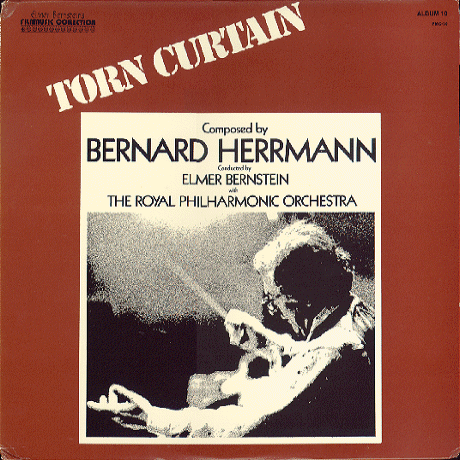
     The film Torn Curtain has the notorious reputation of being the film which shattered the collaborative partnership between Alfred Hitchcock and Bernard Herrmann.  In short, Herrmann disregarded Hitchcock's wishes and Hitchcock fired him (full story here).  The film was eventually scored by John Addison with a much lighter touch.  Fortunately Herrmann's original score has been recorded a few times (Elmer Bernstein's recording notably being the first), with the most recent being the Varese Sarabande rerecording conducted by Joel McNeely.  With a little bit of guesswork, it's fairly easy to place Herrmann's unused cues into the film sequences for which they were written and in the analysis below I've included time codes for placement of the McNeely-conducted tracks.  Not to demean Addison's score, but by watching the film and cueing up the Herrmann McNeely tracks at the indicated times, the film has a much more "classic" Hitchcock feel.

     Plot-wise, a scientist (Michael Armstrong) is on his way to a science conference when he announces to his fiancee Sarah that he must abandon the conference and take a side trip.  She follows him and they end up in East Germany, behind the Iron Curtain.  The scientist "defects" with a public announcement, but in reality is in Germany only to spy on a fellow scientist.  The film's midpoint climax comes when Michael is forced to kill his German "handler" Gromek with his bare hands (unscored in the final film, Herrmann apparently originally wrote suspenseful textures for the later stages of the fight climax).  Eventually, the German authorities discover the subterfuge and Michael and Sarah must race to escape from behind the Iron Curtain, with the help of an "underground" rebel bus line organized by the "Pi" resistance group.


Start Time Trk Title Film Sequence
0:00 1 Prelude Main title over ghostly suspense headshots and colorful skies, dissolve to ship in Norway.
2:00 2 The Ship (Cue from appearance of "OSTERFJORD, NORWAY" title) 
Passengers on the ship suffer from the cold temperature.
6:03 3 The Radiogram (Cue from opening cabin door) 
Michael receives a mysterious message.  Downstairs he writes a reply while dodging Manfred, a German scientist.
8:09 4 The Hotel (Cue from overhead street shot) 
The couple arrive at the Copenhagen hotel and get comfortable in their rooms.  Sarah picks up a phone call for Michael from a bookstore.
9:03 5 The Phone (Cue after "Michael, it's some bookshop for you")
The phone call is cut off.  Michael tells Sarah to take a stroll without him.  The bookstore calls back and Sarah gets the address.  She goes downstairs and is accosted by Manfred.  She tries to get directions to the bookstore but has language difficulties.
11:15 6 The Bookstore (Cue from Manfred taking the note from Sarah)
Manfred appears and accompanies Sarah to the bookstore.  She receives the book with a warning and then returns to Michael.
13:52 7 The Book (Cue from Sarah seeing Michael getting documents from the hotel desk clerk)
In the bathroom stall, the book reveals a clue to Michael's next contact - "Pi".
15:36 8 Valse Lente (Cue from wide shot of outdoor cafe)
Source music: The couple have a meal and Sarah asks Michael why he's being secretive.  Michael tells her that he has to go to Stockholm on a special mission.  Michael refuses to have her accompany him to Stockholm.
18:23 9 The Travel Desk (Cue from Sarah going through the revolving hotel lobby door)
At the somewhat inattentive travel desk, Sarah finds out Michael is flying to East Berlin, not Stockholm.
20:28 10 The Blurring (Cue from "Hello, Michael")
Michael sees Sarah on the plane and tells her that she has to go back as soon as they land.
32:28 11 Hotel Berlin (Cue from wide shot of Michael's German escort cars approaching the Berlin Hotel)
The entourage arrives at their Iron Curtain hotel.  Michael quietly visits Sarah's room to try to explain why he is defecting.
34:37 12 Sarah (Cue from "Michael, take me home")
Sarah and Michael talk, and Sarah is still stunned at the turn of events.
35:43 13 Dawn (Cue from morning fade in)
In the morning Sarah wakes up alone, and receives a visit from Manfred.
36:59 14 Gromek (Cue from Michael exiting from elevator)
Michael sneaks out of the hotel, and Gromek follows.  Michael takes a bus to the Berlin Museum.
40:25 15 The Farmhouse (Cue from Michael leaving through the Museum's back door)
Michael takes a cab to the farmhouse.  When a woman opens the door, Michael scratches the "Pi" symbol in the dirt with his foot.  She has Michael go towards a man on a tractor.
49:32 16 The Killing (The farm woman's knife breaks off in Gromek's shoulder)
As Gromek wrestles with Michael in the farmhouse, the woman stabs Gromek.  Gromek fights on and tries to strangle Michael.  They drag him to the oven and asphyxiate him.
52:24 17 The Body (Cue from shortly before Michael gets up from the oven of death)
Michael and the woman recover from the fight and discuss the disposing of Gromek's body.  They notice the cab driver outside.
55:10 18 The Street (Cue from Michael on the street)
Michael is met by security agents on the way back to the hotel.  He is driven to Gerhardt's office.
56:39 19 The Toast ("Miss Sherman, may I offer you a cognac?")
Everyone has drinks in Gerhardt's office to celebrate Sarah's decision to stay in Germany with Michael.  Gromek is reported missing.

20 The Photos (Unused scene)

21 The Sausage (Unused scene)
59:20 22 The Fall Michael is tripped by a woman (Koska) who is his contact for escape.
1:03:09 23 The Cab Driver (Cue from tight shot of Gromek notice)
The cab driver realizes that Gromek is missing and reports to the police.
1:10:33 24 The Hill (Cue from medium shot of torn Michael as Manfred talks to Sarah)
Michael tells Sarah the truth about his mission.
1:12:44 25 The Search (Cue directly after kissing scene)
Police search the farmhouse.
1:19:42 26 Discovery (Cue with digging sequence)
Gromek's motorcycle and body are found.  Security forces approach the hospital where Koska and Sarah wait for Michael.
1:20:44 27 The Blackboard (Cue from Michael and Professor Lindt walking in the corridor, "I wonder what happened to our security man?")
Michael and Professor Lindt discuss weapons tech and enter Lindt's workroom.  Lindt erases the blackboard and gives the chalk to Michael.
1:26:37 28 The Formula (Michael says "Ah..." after Lindt slams down the chalk)
Michael works at the blackboard and tricks Lindt into revealing his secret formula.
1:28:00 29 The Corridor (Cue from bustling corridor shot)
Michael evades the guards at Lindt's school.  He meets Koska and Sarah and they prepare to escape.
1:29:30 30 The Bicycles Michael and Sarah bicycle to the rendezvous.  They board the PI escape bus and are disguised.
1:32:44 31 The Bus (Cue from the Pi leader seeing the roadblock through the front windshield)
The Pi bus is stopped and searched by a guard.  Their helper Jacobi successfully hides Michael and Sarah.  (This is kind of a guess, but seems to fit)


John Addison score:
1 Main Title Main title over ghostly suspense headshots and colorful skies, dissolve to ship in Norway.
2 Love Theme Michael and Sarah in bed on the ship, and when they arrive at the hotel.
3 Behind The Curtain Sarah is rebuffed by Michael at dinner, and soon finds out that Michael is secretly going behind the Iron Curtain.
4 Introduction To Pi Michael receives the secret message from Pi in the book.
5 Premonitions Of Trouble Variations of suspense music used throughout.
6 Variations On The Love Theme
7 Bus Theme Variations
8 Sarah Alone Paul speaks to Sarah alone after the press conference.  Sarah asks to be taken home.
9 The Murder Of Gromek The cab driver realizes that Gromek is missing and reports to the police.  The police investigate the farmhouse.
10 Michael And Sarah, Alone Of The Hill Michael tells Sarah the truth about his mission.
11 Escape On The Pi Bus Michael and Sarah board the Pi bus.  They encounter a roadblock inspection, bandits, and eventually get escorted by soldiers.
12 End Title The escape basket reveals its empty contents (Michael and Sarah have already escaped).


Links
Talk on the Wild Side, Elmer Bernstein remembers his friend Bernard Herrmann (2003)
Herrmann and Hitchcock, The Torn Curtain (Steve Vertlieb, 2002)

Wednesday, June 8, 2016

Citizen Kane (Herrmann, 1941)

     Bernard Herrmann's score to "Citizen Kane" is an amazing tour-de-force of stylistic synergy in a musical narrative, and the fact that it was his very first film score makes it even more impressive.  However, Herrmann did have the advantage of working previously with director Orson Welles on dozens of live radio dramas in New York City (and also, working with a feature often voted "the greatest film ever made" doesn't hurt).

     Brought in fairly early in the filming process, Herrmann worked with Welles and editor Robert Wise very closely, and even recorded the opera source music before the scene was actually shot.  The rest of the score was recorded at the end of 1940 and the beginning of 1941.

     The backbone of the film is a reporter's search to the mystery of "Rosebud", Kane's last utterance, and these framing sequences are scored with appropriately gothic and morbid textures.  The interviewee's flashbacks are populated with optimistic early 20th-Century jazz-flavored dances, in line with such classical works as Bizet's "Carmen" (Les Toreadors), Offenbach's "Orpheus" Galop, Khachaturian's "Sabre-Dance", etc...  One of the most skillfully-crafted musical sequences of the film is the "Theme and Variations" which twists around a Viennese waltz to musically symbolize the gradually-cooling marriage between Kane and his first wife over a montage of breakfast sequences.  Another notable cue is the complex source music for the opera scene mentioned earlier, in which Kane's second wife Susan has to sing "badly" (but not so bad that it is unrealistic or farcical).

     Thematically, there are 3 main motifs which occur:
  • Destiny motif (or "Power motif"): 5 note figure, falling on the 2nd note, rising on the 3rd, repeating, then falling (this sequence is ingeniously symbolic of Kane's fall from childhood innocence, rise to fame, two marriages, and eventual lonely death).
  • Rosebud motif: Rising theme which zig-zags upwards (striving towards goodness, innocence).
  • Inquirer motif: Sardonic, humorous figure associated with Kane's newspaper, reflective of the "pulp" nature of his reportage.
     The Destiny and Rosebud motifs are generally applied in a style which would eventually come to be known as "Herrmannesque": dark, nuanced, psychologically complex.  The opening Prelude (probably one of the most brilliantly-crafted pieces of cinema and music in the last century and described in more detail below) eventually leads to the early Inquirer newspaper scenes, which use optimistic, entrepreneurial dances as their basic flavor, reflecting the ambitions of a young man in America.  These cues include:
  • Galop
  • Kane's New Office
  • New Hornpipe Polka
  • Carter's Exit ("Exit theme")
  • Chronicle Scherzo
  • Bernstein's Presto (unused)
  • Kane's Return ("Exit theme" reprise)
  • Kane Marries (dance arrangement of Mendelssohn Wedding March)

     Beginning from Kane's first encounter with Susan, the musical tone becomes somewhat more psychologically-layered, as the Destiny and Rosebud motifs fight for dominance.  Near the end, a final bit of "jazz" is visited in "Kane's Picnic", but instead of an energetic dance, the texture is steeped more in cheap squalor and stubborn futility.  The Finale revisits material from the Prelude, and finally answers the mystery of Rosebud (Herrmann notes that the music has given away the secret very early on, as the Rosebud motif is heard when young Kane is first seen playing on the eponymous sled).

     There have been 5 notable re-recordings of the Citizen Kane score (though the original score has sadly never surfaced):
  • Herrmann-conducted "Welles Raises Kane" Suite with the London Philharmonic Orchestra (1968)
  • Charles Gerhardt's Citizen Kane Suite with the National Philharmonic Orchestra (with Kiri Te Kanawa) (1974)
  • Tony Bremner's complete score with the Australian Philharmonic Orchestra (with Rosamund Illing) (1991)
  • Joel McNeely's complete score with the Royal Scottish National Orchestra (with Janice Watson) (1999)
  • Rumon Gamba's complete score with the BBC Philharmonic Orchestra (with Orla Boylan) (2010)
     The below analysis uses the track timings from the Gamba recording, since the Bremner and McNeely recordings have individual tracks for most of the cues and so timings are not necessary (I mostly used the McNeely recording for the analysis itself, however).  All 5 recordings have their own virtues, and sometimes differ in their orchestrations (the Bremner recording is also notable in that it is the only release which includes the "opera collage" sequence).  The film score also uses a variety of tracked sources (including the "News of the World" film-within-a-film holding 31 edits!) and the listing for these cues can be seen in the Citizen Kane cue listing.


Trk Time
Code
Title Film Sequence
5
(8:10)
0:00 Prelude 0:00: No Trespassing sign, slow pan up steel fence to distant shot of Xanadu with "K" gate in foreground, overlaid with monkeys in cages.
Destiny motif in low brass/winds/gong, then in low winds.
0:21: Rosebud motif in low brass/winds, Destiny motif in low winds becoming a 2-note figure in contrary motion.
Montage of zoo, boat dock, golf course, etc. leading to exterior lit bedroom, which suddenly goes dark.
0:58: Rosebud in vibraphone, falling wind figure, Destiny motif in low winds, then repeated with brass/timpani swell, rest.
1:41: Interior bedroom fades into snow globe miniature house close up.  Camera quickly pulls back and Kane drops the snow globe ("Rosebud...")...
Rosebud in winds, developed, rest.
2:05: Snow globe rolls and shatters, and Kane apparently dies.  A nurse pulls the sheets over his face.  The sun rises.
Rising vibraphone/muted brass into accent and winding low winds, Destiny fragment in muted brass, Rosebud in winds/vibraphone, falling low winds/strings/gong end cadence.
(followed by library music under "News on the March" describing Xanadu, the death of Charles Foster Kane, and the history of the Kane news empire; Kane's controversial personal history).
2:56 Rain
(Susan In Nightclub)
(Partially used, fades into jazz source) Camera pans outside the El Rancho nightclub, featuring Susan Alexander Kane.
High, hypnotic, wavering layers in winds/strings/vibr./celeste joined by wind counter figures, modulating upwards, low winds climb and waver. 
4:06 Thatcher Library
(Litany)
At the mausoleum-like Thatcher Memorial Library, Thompson is given strict instructions on his access to Thatcher's diary manuscript.
Reverent ("Greek antiquity" texture) variation of Destiny motif in muted brass/harp/winds, reverent figure in low winds, subdued muted trumpets.
5:11 Manuscript Reading And Snow Picture After the vault door is closed, Thompson reads Thatcher's diary entry about Kane in a starkly lit room.
Accent into subdued reverent muted brass, reverent figure developed and joined by "tic toc" winds/harp ostinato.
(Partially used, 5:56) Camera focuses on Thatcher's diary account and dissolves into a snowy scene with Kane as a child riding a sled and throwing a snowball.
Layers of high wind and string trills build into harp glissando followed by Rosebud motif in strings, harp gliss into muted brass accent, chimes, playful high wind/harp dialogue, rising vibraphone into end wind accent.
6:33 Mother's Sacrifice Kane's mother calls to her son outside.  She somberly prepares to give her son over to Thatcher's care.  Outside, she introduces Charles to Thatcher.
Destiny motif in low brass/tremolo strings, falling strings, joined by regretful clarinet.
7:24 Charles and Thatcher Charles knocks Thatcher into the snow with his sled and tries to run away.  His father threatens him and Charles gives Thatcher a dirty look.
Brief subdued oboe/brass fanfare, rising string figure building to tense accent.
Camera holds on the abandoned sled gathering snow.
Rosebud motif in bassoon/tremolo strings.
Dissolve to a somewhat unhappy Charles getting a new sled from Thatcher at Christmas.
Sleigh bells, wind trills.
6
(7:15)
0:00 Galop Montage of Thatcher reading Kane's Inquirer newspaper and its exposes of the bank trusts and other financial institution abuses, as well as a suspicious story about Spanish galleons near New Jersey.  Ends with Thatcher confronting a calm Kane.
Galop/can-can rhythm in layers of brass/winds/percussion/strings, flute/oboe solos, ending in brass/drums cadence.
0:48 Dissolve To Thatcher Reading Document Kane jokes that at his current rate of financial loss, he will have to close the Inquirer in 60 years.  Dissolve to Thatcher's diary and the Depression's effects on Kane's paper.
Sardonic Inquirer motif in muted brass figures leading into subdued Destiny motif in brass/timpani.
1:04 Second Manuscript (Partially used) Kane tells Thatcher that he would have liked to have been a different man, one that Thatcher would have hated.  In the present, Thompson continues reading the Thatcher manuscript.
Destiny motif developed in muted brass layers, joined by high tic-toc wind ostinato.
1:50 Thanks Thompson wryly thanks the Thatcher Library custodians; scene changes to an interview with Bernstein.
Sardonic muted brass/high wind figures.
1:58 Bernstein's Narration (Unused) Bernstein reminisces on a the fleeting glimpse of a girl from the past, and reflects on Kane's passing.
Pastoral flute over gently rocking string rhythm, poignant winds.
3:18 Kane's New Office (Partially used) Kane, Leland and Bernstein arrive at the newly-bought Inquirer newspaper building and staff.
Inquirer motif in clarinet joined by brass rhythm/drums with Destiny motif in trumpet figures, developed on trumpet, trombone, etc.
4:14 New Hornpipe Polka Kane moves in to Carter's office, and decides to have the paper open 24 hours instead of just 12.
Tic-toc low winds/percussion joined by can-can wind rhythm, developed and ending in a wry wind cadence.
4:57 Carter's Exit Carter indignantly leaves the Inquirer building.  Kane, Leland and Bernstein work through the night to prepare the next morning's paper.
Can-can "Exit" rhythm in winds and brass dialogues, ethereal strings and subdued winds.
5:38 Chronicle Scherzo Kane's "Declaration of Principles" is printed on the Inquirer front page.  In a montage, Kane acquires the staff of the competing Chronicle newspaper.
Dance-like brass rhythm with timpani/xylophone and developed wind dialogues, joined by percussion and strings.
6:52 Bernstein's Presto (Unused) Bernstein tells Leland that he has received a cable from Kane in Paris.
Exuberant can-can rhythm in brass/timpani, winds/snare.
7
(7:38)
0:00 Kane's Return Kane returns from a trip abroad with a special "social" announcement.
Can-can "Exit" rhythm in brass/timpani, wind/brass/pizz string dialogues.
0:30 Collecting Statues (Unused) Inquirer motif in winds/muted brass, harp gliss into pizz bass figure.
0:45 Valse Presentation (Partially used) Leland and Bernstein see Kane with his new fiance, a niece of the President's.  Scene cuts back to present and Bernstein talking with Thompson.
Romantic string waltz with pizz rhythm, joined by wind ornaments, ending in brass/wind flourishes.
1:51 Sunset Narrative Thompson visits Leland at the hospital.  Leland speaks well of Kane but with some subtle bitterness.  He begins talking about Kane's first marriage.
Muted brass/tremolo strings, hesitant low textures becoming wistful winds/ string figures, joined by dialogue of muted brass, poignant strings and reflective winds.
4:32 Theme And Variations: Theme:
Valse Tempo
Kane and his first wife Emily enjoy an intimate breakfast.  Kane compliments her beauty.
Theme in a graceful mid-tempo string waltz ending with wind ornament.
5:29 Var. I.
Allegretto Scherzando
Emily criticizes Kane for being late.
Theme in staccato wind and pizz. string figures, ending in muted brass accent.
5:47 II.
Presto
Emily becomes jealous of the newspaper.  Kane criticizes her uncle the President.
Theme as a dialogue between tremolo high winds and haughty muted trumpets/horns, supported by harp/pizz. string accents, ending in muted brass.
6:16 III.
Allegretto
(Unused) Playful staccato figure echoed as a dialogue in various winds and strings, ending in harp gliss and soft string cadence.
6:33 IV.
Allegro Agitato
Kane and Emily get snippy about Bernstein's gift.
Alarmed/accented winds/strings against bass plucks, muted brass, theme fragment building in strings.
6:55 V.
Lento
When Emily criticizes Kane's paper, Kane snaps at her.
Dark muted brass/winds/harp into Destiny motif in forlorn muted horn.
7:07 VI.
Valse Lento
Emily begins reading the Chronicle at the table in silence.  Montage ends and scene cuts back to Leland and Thompson.
Cold, ethereal strings (variation of Destiny motif) with harp rhythm.
8
(5:40)
0:00 Kane Meets Susan After Kane is soiled with mud, Susan offers him some hot water in her apartment.  Susan moans about her toothache.  Kane closes the door to Susan's bedroom.
Rosebud motif in violin over soft strings/harp (or clarinet) arpeggio, string accent.
0:27 Susan's Room 0:00: Kane and Susan flirt in her bedroom.  Kane wiggles his ears and makes shadow figures to amuse Susan.  Susan claims to not know who Kane really is.
Gently rolling strings joined by Rosebud motif developed in flute/violin, clarinet/soft strings, soft strings/harp arpeggio with Rosebud motif in flute, clarinet.
2:06: Kane tells Susan that he was originally on his way to a warehouse to search for his lost youth among the items.
Soft falling strings, rising-falling clarinet.
2:39 Mother Memory (Unused) Alternate version of Susan's Room part 2.
Soft falling strings, rising-falling clarinet, high string tremolo.
3:11 The Trip to Susan's Emily tells Kane that she is going to visit Susan's address.  Kane joins her and they arrive at Susan's doorstep ("I had no idea you had this flair for melodrama, Emily.").
Eerie held textures in winds/organ/bass drum (or vibraphone and brass).
4:07 Gettys' Departure Gettys and Emily leave Susan's doorstep.  A sordid story of Kane and Susan is published.  Leland is disappointed.
Eerie figures in contrary motion joined by growing strings/brass, drum and brass end cadence.
4:39 Kane Marries Kane marries Susan and tells reporters that he plans to make Susan an opera star.
Roy Webb arrangement of Mendelssohn Wedding March with a triumphant fanfare.
9
(4:12)
0:00 Salammbô's Aria A frantic scramble precedes Susan's appearance on the Chicago opera stage.  When Susan begins singing, the camera pans up towards some stagehands expressing their disapproval.  Later in Susan's subsequent flashback, Leland is seen making paper cutouts out of the program notes, and Kane overhears some mocking voices.
0:00: Exclamatory brass figures with wind and percussion accents, leading to sweeping strings, brass/string tremoli, dark brass/string/percussion cadence.
0:40: Vocal recitative supported by tremolo strings with poignant brass figures, wind ornaments, harp gliss.
1:31: Soft string rhythm supporting swaying aria with wind ornaments, brass swells.
2:41: Aria cont'd with brass fanfares, wind ornaments/string accents.
3:10: Aria with swelling tutti figures, building to a soaring climax.
10
(7:10)
0:00 Leland's Dismissal (Partially used) As Kane finishes Leland's negative review of Susan's performance, he tells Leland he's fired.  The scene cuts back to the present with Leland and Thompson.
Dark winds/brass/timpani swells into accents, muted, sour Inquirer motif in brass figures, forlorn winds, eerie held winds/organ.
1:10 New Dawn Music (Partially used, fades into jazz source) Leland leaves with his nurses.  Scene cuts to a Susan Alexander Kane poster below the El Rancho nightclub sign.  The camera pans in through a window to Susan and Thompson.
Slow, optimistic muted brass figure into "tic-toc" winds/relaxed strings/vibraphone.
2:05 Xanadu Xanadu is seen in the murky distance.  Inside, Susan works on a jigsaw puzzle.  Susan complains to Kane that she is lonely and misses New York.  Kane resists.
Destiny motif in suffocating, muted brass, accents, Destiny developed in winds, muted brass, joined by tremolo strings/vibraphone accents, falling brass figures, partial Rosebud in muted brass, cut off by timpani/low winds.
4:11 Jigsaws (Partially used) Montage of Susan working on jigsaw puzzles.
"Perpetual motion" tic-toc rhythm in woodblock with wind trill accents/held piccolo, joined by pizz. string rhythm (ending in string swell, unused).
5:30 Second Xanadu Kane asks Susan about her jigsaw puzzles.  Susan criticizes his statue collecting.  Sitting far away, Kane tells Susan that he is planning a picnic for her and the guests, but Susan is not very interested.
Unused: Brass alarm fanfares, low winds/timpani accents.
5:43: Winding flute ostinato/ethereal strings, developed in winds, joined by Destiny motif in horns, falling-rising wind phrase, distant muted trumpet fanfares.
11
(8:28)
0:00 Kane's Picnic In the back of a car, Susan tells Kane that he never gives her anything she really cares about.  A caravan of cars slowly crawls along the beach.
Sardonic muted brass/bassoon over lumbering piano/string/perc. rhythm ("Tempo d. Blues").
0:26 Susan Leaves (Unused in film)
Gamba "extended" version:
Soft muted Destiny winds/Rosebud clarinet variation joined with bass plucks, muted Destiny brass, Rosebud bass flute/timpani, rest...Soft muted Destiny winds/Rosebud clarinet variation with bass plucks, muted Destiny brass,  Rosebud bass flute/timpani, developed on winds, bass plucks, timpani, rest...Soft muted Destiny winds/Rosebud clarinet variation with bass plucks, muted Destiny brass, Rosebud bass flute, falling winds with bass plucks.
McNeely version:
Soft Rosebud/Destiny motif developed in bass flute/clarinet, joined with bass plucks, soft muted Destiny winds joined with bass plucks, muted Destiny brass, Rosebud bass flute, falling winds with bass plucks.
2:51 El Rancho In the present, Susan notices that it's morning.  The camera pulls back to the El Rancho nightclub sign and then cuts to the "K" on Xanadu's metal gate, as Thompson begins interviewing Raymond.
Gentle winds rhythm joined by strings, interrupted by harsh brass/timpani Destiny motif as accents, Rosebud winds (cue repeated 2x on Gamba version).
4:23 The Glass Ball In Raymond's flashback (after Kane has trashed Susan's bedroom, picked up a nostalgia-inducing snow globe, and tearfully muttered "Rosebud"), Kane walks out of the room past stunned servants, slipping Susan's snow globe into his coat pocket.  He passes a hall of mirrors.  The scene returns to Raymond and Thompson in the present.
Low pulses, joined by uneasy Rosebud motif in bass flute/viola, developed in strings/muted horns, winding oboe/bassoon, Destiny in muted horns (with trombone accent, unused).
5:51 Finale The reporters leave Xanadu and the camera pans over a seemingly infinite number of crates and souvenirs.  It finally lands on a sled. 
Somber wind/brass/string textures, Destiny in muted brass, low winds, rising muted horns over low pulses, bassoon figure, Destiny in distant brass.
The sled is picked up and tossed into a fire, where the word "Rosebud" is seen on it's face, melting away.
Wind/string trill over timpani roll/accents, ominous muted brass, building to Rosebud in tremolo strings/brass, wind trills, developed.
The camera dissolves to an exterior shot of smoke from the chimney rising into the sky.
Timpani swell into brass/timpani Destiny fanfare, developed.
The scene dissolves to a descending pan over the Xanadu fence back to the opening No Trespassing sign, followed by a long shot of Xanadu with the "K" gate in the foreground.
Destiny in distant muted brass, building to ending brass cadence.


Links
Citizen Kane Score Wiki Entry
Citizen Kane Cue Sheet 
"Score for a Film: Composer Tells of Problems Solved in Music for 'Citizen Kane'" (New York Times, May 25, 1941, Bernard Herrmann)
Bill Wrobel Rundown of Citizen Kane (PDF)
Citizen Kane Leitmotifs and Rachmaninoff’s Isle of the Dead (Mark Richards essay)
The Film Music Of Bernard Herrmann: Hangover Square & Citizen Kane (Rumon Gamba, PDF notes)
Citizen Kane (Film score with dialogue/FX) on Spotify
Citizen Kane (Rumon Gamba) on Spotify
Citizen Kane (Joel McNeely) on Spotify
Citizen Kane (Bernard Herrmann rerecording) on Spotify 
Citizen Kane ("The Symphony Orchestra" rerecording, includes Newsreel source) on Spotify

Monday, May 9, 2016

Vertigo (Herrmann, 1958)

     The director-composer relationship between Alfred Hitchcock and Bernard Herrmann is a legendary one and probably reached its zenith in 1958's "Vertigo" (though frankly there are MANY contenders for this title in their joint filmography).  In any case this production showcases a virtually perfect example of how music enriches a film sequence and provides narrative information to the audience even without them knowing about it.

     In this film, a detective, Scottie, finds out that he has a fear of heights.  He is soon hired to follow an old friend's wife, Madeleine, who acts as if she is possessed by an ancestral spirit.  Eventually Scottie falls in love with Madeleine, but she falls to her death, due partially to Scottie's affliction with vertigo.

     After a nervous breakdown, Scottie runs across a woman, Judy, who looks like the dead Madeleine and tries to remake her into the dead woman.  In reality, Judy IS Madeleine, as she had earlier pretended to be Madeleine in order to help Scottie's old friend stage a suicide.  In any case, the main theme of the film is Scottie's obsession with the dead woman and his desire to create a false reflection of her, despite the fact that Judy really IS Madeleine. 


Prelude Structure
     Musically, the Prelude provides a Main Title which is a kind of crystal encapsulation all of the musical motifs which will unfold in the ensuing picture.
  • Intro (Fanfare): Falling/rising triplets in contrary motion on violins/winds/vibraphone with 4 slowly descending brass chords.  This 4-note falling motif (and variations) occurs many times and is a variation of the Love theme ending.
  • A: Contrary motion motif in harp/celeste, with the 4-note motif as isolated brass accents with flute/clarinet/vibraphone/violin triplets.  The 4th accent features Hammond organ.
  • Bridge: Rising violin/flute trills.
  • B: Contrary motion motif and 4-note motif developed in sweeping brass/winds and flute/clarinet/string arpeggios.
  • A': Cascading variation of falling/rising contrary motion motif with 4-note descending brass motif.
  • B: Contrary motion motif and 4-note motif developed in sweeping brass/winds and flute/clarinet/string arpeggios.
  • Coda: Pizzicato variation of  falling/rising motif as coda.
     Herrmann creates several themes from the Prelude by stacking notes or shifting intervals into different shapes, but still maintaining a distinct rising/falling, somewhat "reflective" feeling.
  • Pursuit motif: a churning, compressed version of the Prelude theme as a suspense ostinato, supported by swelling brass, and used on the rooftop and whenever Scottie climbs stairs.
  • Vertigo motif: swirling polychord (derived from Prelude theme) featuring brass and wild harp glissandi, used for when Scottie experiences vertigo.
  • Love theme: a sweeping love theme starting with 3 rising notes going into 4 slow falling notes (the 4-note motif from Prelude).  The 4-note motif is repeated with ornaments and modulated.  The Love theme first appears in "Farewell" when Madeleine briefly hints at her true feelings.  It haunts Scottie in the second half of the picture. 
  • Madeleine theme: slow wandering figure which first appears in the beginning of track 2's "Madeleine", a somewhat melancholy "unfulfilled" version of the Love theme (3 rising, 3 falling, 1 rising and then falling, etc..).  Vertigo is largely made up of many complex Madeleine variations, though in the table below I sometimes just say "Madeleine's theme" for brevity's sake.
  • Carlotta motif: Spanish "habanera" 4-note rhythm on one pitch, usually with a counter figure.
  • Following motif: irregular 6-note rhythm used whenever Scottie spies on Madeleine.

     The below listing is based on the 1996 expanded Varèse Sarabande release of the soundtrack to Vertigo (original recording conducted by Muir Mathieson, partially in mono), though the descriptions below should be handy when listening to the 1995 rerecording by Joel McNeely as well (except for "Scottie Trails Madeleine", which is a slightly different cue ending than the Mathieson recording).  The table below describes the film sequences for each cue and a brief note about the music elements.

     The musical analysis here is admittedly scant for a complex score such as this, and in fact an entire book by David Cooper has been written about this score (which I don't have, unfortunately), as well as innumerable theses and music papers.  Tom Schneller's paper on the Farewell scene is especially interesting and was helpful in identifying a few theme transformations (see link at bottom).  I'm very tempted to write "full analyses" of certain favorite cues (perhaps another day), but suffice to say that each cue is a perfect microcosm of musical drama, and each also serves as a case study in film scoring at its highest level. 

Trk Dur Title Film Sequence
1 4:44 Prelude 0:00: Logos, Titles over woman's face (Intro fanfare, Prelude A).
0:59: Spiral imagery begins (Bridge, Prelude B).
1:44: (Cascading variation: Prelude A').
2:20: Music credits (Prelude B).
2:44: A spiral image settles into woman's eye, director credit (Coda).
Rooftop 2:58: Scottie and a policeman chase a suspect over rooftops. Scottie ends up hanging by his fingertips after an attack of vertigo (Pursuit motif in layers of swirling strings/winds, swelling brass figures).
3:48: A policeman falls to his death when he tries to help Scottie (timpani roll into Vertigo motif (dissonant brass/vibraphone/harp strums, etc), ending in rising brass figure and timpani roll).
2 6:19 Scotty Trails Madeline
(suite of 6 cues)
0:00: Madeleine (Madeleine's 1st Appearance): Scottie is fascinated when he sees Madeleine at Ernie's restaurant (Madeleine theme developed on violins over soft strings, ending on poignant cello figure).
1:16: Madeleine's Car: Scottie follows Madeleine's car (Following rhythmic motif on clarinets/bass clarinets, joined by Madeleine theme developed on violins, then Following rhythm on strings/Madeleine theme on clarinet/oboe, back to Following motif on clarinets/Madeleine on strings).
3:09: Scottie follows Madeleine into a dark building (Following motif in pizz strings and low winds, falling clarinets, strings).
3:50: The Flower Shop: Scottie spies on Madeleine shopping for flowers (yearning Madeleine theme in violins over soft clarinets).
4:25: Alleyway: He returns to his car before Madeleine exits (harp strums and short string figures, clarinet ornaments).  Madeleine gets in her car.
5:02: The Mission: Scottie follows Madeleine as she drives to Mission Dolores.  She enters and he follows (slowly descending organ/wind/string layers).
5:41: Mission Organ: Source music inside the mission, Madeleine exits to the connected graveyard and Scottie follows (church organ theme).
3 1:57 Carlotta's Portrait 0:00: Scottie observes Madeleine at the art gallery sitting in front of a portrait.  He notices that her flowers and hair echo the painting's subject.  He learns that the painting is a "Portrait of Carlotta" (Carlotta motif in harp under slow figures in flutes, clarinets, muted horns, etc., supported by violins/vibraphone).
4 2:59 The Bay 0:00: Scottie follows Madeleine as she drives to the base of the Golden Gate Bridge inside the Presidio (hopeful Madeleine theme variation on viola/celli/horn over harp/violin arpeggio, joined by winds, brass, strings, flute). 
1:00: Madeleine exits her car and drops flowers into the water as Scottie looks on, puzzled (delicate vibraphone with held string textures/wind ornaments).
1:52: Madeleine jumps into the bay (horn/string fanfares with high falling wind figure) and Scottie rushes to retrieve her unconscious, floating form (rising/falling wind/string figures and tremolo strings).  He puts her in his car and drives them both back to his apartment (soft strings variation of Madeleine theme).
5 2:56 By the Fireside 0:00: Scottie leaves Madeleine in his bedroom so she can get dressed (4-note motif as falling suspense violins).
0:20: Madeleine enters the living room in his bathrobe and suspiciously asks Scottie what is going on (Madeleine theme developed on poignant violins).  They discuss her trips to the Presidio (thoughtful variation, hesitantly returning to poignant feeling).
6 2:25 The Streets 0:00: Scottie follows Madeleine's car again and is puzzled by her random path.  She finally ends up at Scottie's own apartment (Following motif in strings with Madeleine theme in winds, strings, winds, ending in a rising falling figure in various instruments).
7 3:48 The Forest 0:00: Scottie and Madeleine walk in an old forest and discuss the past (foreboding 2-note figures as swells in muted brass/bass, rising brass/wind harmony alternating with falling figures).
1:21: Madeleine looks at the rings inside a cut tree trunk and makes strange statements (2-note figure developed into 8-note figure in eerie high winds and muted brass).
"Somewhere in here, I was born, and there I died."
1:58: Madeleine disappears from view behind a tree (throbbing organ/low winds/vibraphone).
2:31: Scottie finds Madeleine in a daze and tries to psychoanalyze her (8-note figure in eerie high winds with organ, low winds, rising falling muted brass harmonies).
3:28: Scottie escorts her out of the forest (resigned cor anglais ending figure).
8 3:31 The Beach 0:00: Scottie and Madeleine talk on a small beach (poignant strings variation of Madeleine theme with horns, bassoon, cor anglais).
0:39: Madeleine describes walking down a dark corridor towards darkness and a lonely room (slowly falling strings in 2 layers with intermittent flute/clarinet chords).
1:38: She describes a graveyard image (swelling trombone/tuba, low clarinets).
2:03: Madeleine describes a dream of a Spanish bell tower with a garden below it (Carlotta motif in violins with flute, clarinet).  She worries that she is going mad (tremolo strings).
2:39: Madeleine runs off and Scottie pursues her (poignant Madeleine winds/strings).  They embrace and then finally kiss as waves break on the rocks behind them (triumphant sweeping Madeleine brass/winds/tremolo strings).
9 2:46 The Dream 0:00: Madeleine visits Scottie and claims to have had another bad dream (poignant Madeleine variation in falling violins).
0:32: Madeleine describes the dream's details.  Scottie tells her that the dream's location is a real Spanish mission (Carlotta motif in violas joined with dialoguing clarinets, strings, flutes, with vibraphone accents).
2:06: Scottie tries to comfort Madeleine and offers to take her to the mission (variation of beginning section: poignant Madeleine variation in falling strings).
10 6:58 Farewell 0:00: Scottie and Madeleine drive down the highway.  Madeleine looks somewhat guilty (reprise of The Bay opening: hopeful Madeleine theme variation on viola/celli/horn over harp/violin arpeggio, joined by winds, brass, strings, flute arpeggios).
0:40: The couple arrive at the Spanish mission, San Juan Batista (Carlotta motif in flute/violins/brass).
1:12: Scottie questions Madeleine as she sits in a carriage in the livery stable.  She talks of her past visions (high falling, rising winds/strings over Carlotta motif in horns/harp accents).
2:33: The two embrace and kiss (strings/winds play Love theme fragments into Madeleine theme (2:41)).
3:16: Madeleine tells Scottie that "It's too late" and runs off (Madeleine theme fragments repeated and transformed).  Scottie catches up with her but she seems torn (Love theme finally achieved, briefly, at 3:58).
"If you lose me, then you'll know I...I loved you and I wanted to go on loving you."
4:05: Madeleine tears herself away from Scottie and enters the mission church (Love theme again twisted into a poignant variation on brass, tremolo strings).
Tower 4:18: Scottie sees the bell tower and chases Madeleine into the church, but finds the main hall empty (Vertigo chords in brass, winds).
4:36: Scottie sees the stairs up to the tower and begins climbing after Madeleine (Pursuit motif in strings/brass intercut with soft Vertigo harmonies in vibraphone/winds/muted brass).  He experiences vertigo attacks but continues climbing (Vertigo motif in brass/harp, brass tremolo accents enter). 
5:15: Madeleine's body falls past him in a window and ends up lifeless on the ground (high winds/brass/harp, percussion crash, brass/timpani roll). 
5:36: A panicked Scottie begins climbing back down the stairs (Vertigo chords in brass, soft brass/wind swells). 
6:06: He exits the church as Madeleine's body is found by church staff (low brass figures). 
6:29: The scene cuts to Scottie's trial (mysterious high string and low wind figures).
11 3:33 The Nightmare 0:00: Scottie visits Madeleine's grave (Love theme in violins, joined by winds).
0:32: Scottie begins to have a bizarre nightmare with images related to Carlotta and her flowers, as well as a necklace (low winds joined by rising tremolo viola and violin figures and Carlotta's motif in horns/strings/tambourine/castanets, etc.).  Scottie approaches an empty grave (Carlotta motif in low brass).
1:34: Scottie's head is seen falling down a tunnel, followed by a falling silhouette (layers of rising string/wind figures, joined by rising horns/tubas, Vertigo brass chords).  Scottie wakes up in a panic (cymbal crash).  He is next seen in a mental institution (low brass).
Dawn 2:03: A despondent Midge leaves the institution (despondent low strings). 
2:27: The camera pans across a beautiful San Francisco morning (hopeful harp/strings/winds).  Scottie waits outside Madeleine's old apartment and sees a woman come out (Love theme on brass, winds).
3:11: He intercepts her at Madeleine's old car and finds out she bought it from Madeleine's husband (soft tremolo strings, rising expectantly and ending with an accent).
12 3:14 The Past 0:00: Scottie visits Ernie's restaurant and imagines seeing Madeleine there (Love theme in strings/winds, Madeleine theme in strings, tremolo string harmonics).
0:52: Scottie visits the art gallery and the flower shop where he followed Madeleine to (Carlotta motif in clarinets with fingerboard-bowed strings, resigned strings). 
The Girl 1:26: Scottie sees Judy Barton, a girl who, though very different, looks slightly similar to Madeleine (Love theme in strings).  He follows her and observes her entering the Empire Hotel (camera pans upwards to her upstairs window) (rising string figure).  He goes into the hotel and slowly approaches her door before knocking (poignant Love/Madeleine theme fragments, Love theme becoming thinner and thinner).
13 4:16 The Letter 0:00: After having secured a date, Scottie leaves Judy's room, and Judy appears upset (subdued falling clarinet harmonies).  She has a flashback to the Spanish church where Scottie chased her (as Madeleine) up the stairs.  At the very top Gavin throws a different body from the tower (Pursuit motif in strings/brass).
0:53: The flashback ends and Judy begins to pack (determined string figure with muted horn accents). 
1:20: She pauses to finger Madeleine's suit dress, and then continues to pack (high wind/harp accent, then softer, less decisive string figures).
1:53: She begins narrating a letter to Scottie ("Dear Scottie.  And so you found me...").  She explains that Scottie was just a tool in Gavin's plot to kill his wife.  She admits that she really did fall in love with him and then wonders if she could make him love her for her true self and not the false Madeleine (subdued figures in growing layers of strings).
3:32: Judy rips the letter up and begins to unpack (accelerating fragment of Madeleine variation string figures with soft horn accents).
14 3:07 Goodnight 0:00: Scottie drives Judy back to the hotel and escorts her to her room (peaceful strings).  He insists on seeing her the next day (Madeleine variation in violins over swelling/tremolo strings).
1:25: Judy sits backlit in a green silhouette which further reminds Scottie of Madeleine (Love theme mixed into Madeleine strings).  She reluctantly acquiesces to Scottie's demands and he departs (falling strings).
The Park 2:24: Scottie and Judy enjoy a beautiful day in the park amidst young lovers (cheerful strings/harp/winds, winds, low strings).
15 5:08 Scene d'Amour 0:00: Scottie impatiently waits in Judy's room for Judy to return from dying her hair blonde (Love theme in subdued high strings, developed).
1:12: Judy appears in the hotel corridor.  In her room, Scottie tries to adjust her hair to be more like Madeleine's (suspenseful flute/clarinet harmonies, Love theme in strings growing stronger).
2:15: Judy goes into the other room to complete her makeover into Madeleine, as Scottie nervously waits by the green-lit apartment window (Love theme fragments in tremolo strings (with ghostly harmonics), slowly forming full Love theme, swell).
3:06: Scottie turns and sees Madeleine emerge out of a green fog.  They embrace and kiss (Love theme in soaring strings/harp, rising variations with brass accents).
3:54: The camera pans around them as the background changes to the Spanish Mission livery stable and then back to the hotel room (Love theme briefly develops into a faster dancing figure, ending in a triumphant variation).
16 7:20 The Necklace 0:00: Scottie notices that Judy's necklace is the same one Madeleine and Carlotta wore (flashback to art gallery) (Carlotta motif in horns/flute with 4-note motif).  Judy kisses Scottie, who starts having suspicious thoughts (soft Love theme string/oboe figures intercut with Carlotta motif).
0:50: Scottie and Judy drive at night (falling brass/winds over tremolo strings).  Judy starts to suspect that they are going to the Spanish church as Scottie talks about "freeing himself from the past" (falling flute ornaments with rising horn figures in dialogue with falling flutes/clarinets).
1:53: They arrive at the Spanish mission (falling strings/horns figure).
The Return 2:11: Scottie exits the car and starts telling Judy about his last moments with Madeleine and her oddly ironic last words.  He slowly drags her into the church and towards the stairs while relaying the story (ominous variation of Farewell sequence: Madeleine theme variation on violas/clarinets, violins/bassoons, Madeleine variation fragments repeated and transformed in tremolo/sweeping strings/winds).
3:45: Scottie makes Judy ascend the stairs so he can "save her" this time (wind/muted horn accents/falling violin pizzicato accents join, Madeleine theme becomes exaggerated with accents, ornaments and tempo swings).  He follows and overcomes his vertigo attacks (Vertigo motif).  He pauses at where he originally stopped the last time (Madeleine theme slowly fades in low strings).
Finale 4:55: Scottie drags Judy up into the bell tower room and then interrogates her about what happened the day "Madeleine" died (tremolo/pizz strings and scalar clarinet ornaments, tremolo suspense strings, quiet clarinets)
"And there was where you made your mistake, Judy.  You shouldn't keep souvenirs of a killing."
5:54: Scottie tells Judy how much she meant to him.  Judy kisses Scottie and professes her true love for him (Love/Madeleine theme developed on strings, winds).
6:39: Judy sees a dark shape rise from the shadows and accidentally falls out the window (Hammond organ drone, pause, low brass/timpani crash).  A Church Sister (the dark shape) begins ringing the tower bell as Scottie stands on the ledge looking downwards (Love theme in brass, end cadence).  


Links
Vertigo score Wiki Entry
Bernard Herrmann Wiki
Bernard Herrmann Society
Bernard Herrmann Society Facebook
Vertigo Film Score Rundown 
Film Score Rundowns Herrmann Page 
Herrmann Film Score Lovers Facebook
Death and Love: Bernard Herrmann's Score for Vertigo (Tom Schneller)